
Business Card Paper Stock Explained: A No-Nonsense Guide to 14pt, 16pt, and Beyond
You’ve finalized your design. You know what you want on your card. Then comes the question nobody warned you about: what paper stock should you print on?
It sounds like a minor detail. It isn’t. The paper stock you choose affects how your card feels the moment someone picks it up — and that first tactile impression happens before they’ve read a single word. A flimsy card signals a flimsy business. A card that feels solid and intentional says something entirely different.
This guide breaks down business card paper stock in plain terms — what the numbers actually mean, which weights work for which situations, and how to make a choice you won’t regret when the box arrives.
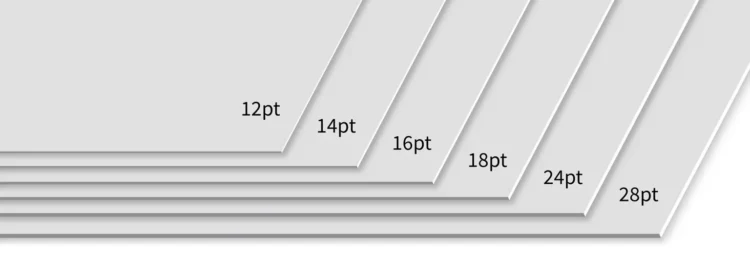
What Does “pt” Actually Mean?
When you see 14pt or 16pt on a print spec sheet, the “pt” stands for point — a unit of thickness, not weight. One point equals 1/1000th of an inch. So 14pt cardstock is 0.014 inches thick, and 16pt is 0.016 inches thick.
That difference might sound negligible on paper (no pun intended), but you’ll feel it immediately when you hold both in your hand. The jump from 14pt to 16pt is noticeable. The jump from 16pt to 18pt or beyond is even more pronounced.
A few things to keep in mind:
Thickness vs. weight: Paper weight (measured in lbs or gsm) and thickness are related but not the same. Two stocks can have the same weight and feel quite different depending on how they’re coated or treated.
Coatings matter too: A 14pt gloss UV card and a 14pt uncoated card feel different even though they share the same base thickness. The coating changes the tactile experience and the durability.
14pt: The Standard — And Why That’s Not a Bad Thing
14pt is the most widely used business card paper stock in the industry. If you’ve handed out or received business cards over the last decade, there’s a good chance most of them were 14pt.
It’s the default for a reason. At this thickness, cards are sturdy enough to survive being carried in a wallet or pocket without curling or tearing, while still being thin enough to fit comfortably in card holders and standard cardstock printers. The weight feels professional without being ostentatious.
14pt is typically paired with either a gloss UV coating or a matte aqueous coating. The gloss option gives colors more vibrancy and pop — especially useful if your design is image-heavy or uses rich, saturated color. The matte option is more subdued and sophisticated, and it doesn’t pick up fingerprints as readily.
Best for: High-volume printing where cost efficiency matters, businesses that hand out large quantities regularly (real estate, retail, food service), and designs that prioritize bold color.
Worth noting: If you’re in a competitive industry or handing your card to someone who receives dozens of them, 14pt won’t necessarily stand out. It’s the baseline, which means it blends in with the baseline.
16pt: The Upgrade Most People Don’t Regret
16pt has become increasingly popular as the go-to choice for businesses that want their card to feel premium without jumping to the higher price brackets. The extra thickness is subtle but tangible — it communicates quality in a way that’s hard to articulate but easy to feel.
At 16pt, a card has more rigidity. It doesn’t flex as easily when held at the edges. That stiffness translates psychologically into durability and credibility. People tend to hold onto 16pt cards longer before discarding them, simply because they feel worth keeping.
Like 14pt, 16pt is available in both gloss and matte finishes. Many print shops also offer soft-touch lamination at this thickness — a velvet-like coating that’s become one of the most popular premium options on the market.
Best for: Professional services (law, finance, consulting, healthcare), creatives who want their physical materials to reflect their attention to detail, and any brand where the first impression is tied closely to perceived quality.
Worth noting: 16pt typically costs more per unit than 14pt, though the difference is usually modest when ordering standard quantities. The per-card cost increase is rarely significant enough to offset the impression benefit.
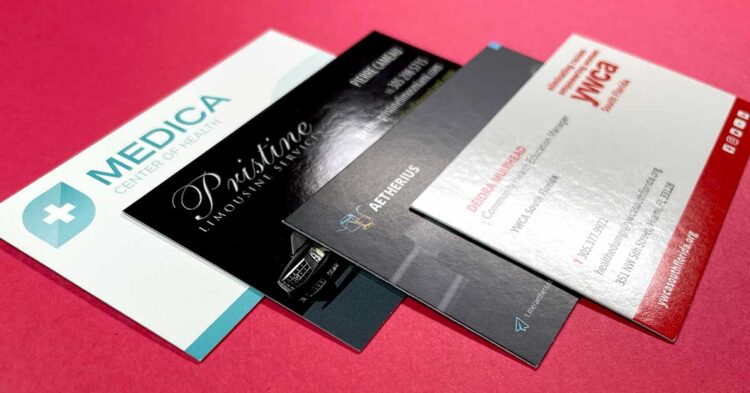
18pt and Above: When Thickness Is Part of the Message
Once you move past 16pt, you’re in premium territory. 18pt, 24pt, and 32pt stocks exist, and they serve a specific purpose: they’re meant to be noticed.
A 32pt card is almost as thick as a credit card. When someone takes it from your hand, there’s a moment of surprise — it doesn’t feel like a business card in the conventional sense. It feels like an object. That reaction, intentional or not, generates a conversation.
18pt: A meaningful step above 16pt. Often used with soft-touch lamination or specialty coatings. Common in luxury goods, high-end hospitality, and premium consulting. Feels noticeably heavier and more rigid in the hand.
24pt–32pt (“ultra thick”): These are typically constructed by laminating two sheets of cardstock together, sometimes with a colored core visible at the edges (called an “edge color” or “painted edge” treatment). The result is a card that genuinely commands attention. Pricing is significantly higher, and they’re not suitable for card holders or slim wallets — but for the right brand, they’re worth every cent.
Best for: Luxury brands, high-end service providers, executives who want to make a specific statement, and situations where you’re meeting fewer people but the impression needs to be lasting.
Worth noting: Thicker stocks can be harder to write on and may not run through standard card scanners or app-based digitizers cleanly. If your clients are likely to scan your cards into a CRM, keep that in mind.
Coatings and Finishes: What Goes On Top Matters As Much As What’s Underneath
Paper stock thickness is only part of the equation. The coating or finish applied on top dramatically changes how the card looks, feels, and holds up over time.
Gloss UV: A high-shine, hard coating applied with ultraviolet light. Protects against scuffs and moisture. Makes colors appear more vibrant. The most common coating on 14pt and 16pt cards.
Matte Aqueous: A flat, non-reflective coating. Colors appear softer and more natural. Cards look more understated and elegant. Easier to write on than gloss. Less fingerprint-prone.
Soft-Touch Lamination: A thin film layer that gives the card a velvety, almost rubbery feel. Highly tactile and memorable. Popular in premium and creative industries. The trade-off: these cards can show fine scratches on the surface over time.
Spot UV: A glossy coating applied only to select areas of the card — a logo, a name, a pattern. Creates a contrast between matte and gloss surfaces on the same card. Visually striking and adds depth to the design.
Uncoated: No coating at all. The card has a natural, slightly textured feel. Colors print slightly warmer and softer. Easy to write on. Common in eco-friendly or craft-oriented brands. Not as durable as coated options but has a distinctive organic quality.
Matching Your Paper Stock to Your Industry and Brand
There’s no universal right answer — but there are better and worse fits depending on what you do and who you’re handing your card to.
Trades and contractors: 14pt gloss. Durable, cost-effective, and the finish holds up when cards are passed around job sites or kept in truck consoles. Focus your budget on a clean, legible design rather than premium stock.
Real estate and mortgage: 16pt with gloss or soft-touch. The industry is visually competitive and relationship-driven. A card that feels premium reinforces the idea that you take your clients’ biggest financial decisions seriously.
Creative professionals (designers, photographers, agencies): 16pt soft-touch or 18pt with spot UV. Your card is a portfolio piece in miniature. It should reflect the same attention to craft that you bring to client work.
Legal, finance, and consulting: 16pt matte or soft-touch. These industries thrive on trust and authority. Understated quality communicates exactly that. Avoid anything that looks flashy or overdesigned.
Retail and hospitality: 14pt or 16pt gloss, depending on volume. High-traffic industries that distribute large quantities of cards benefit from the cost efficiency of 14pt, while upscale venues might lean toward 16pt to match the environment.
A Quick Word on Double-Sided Printing
Most business card stock options support printing on both sides. On heavier stocks like 18pt or 32pt laminated cards, double-sided printing is standard because the laminate holds both sides together structurally.
For 14pt and 16pt, double-sided (called 4/4 printing, meaning full color front and back) typically adds a modest cost but uses the space well. The back of your card is real estate — a clean design element, a tagline, a QR code, or a brief list of services can make the card more functional without cluttering the front.
The one caveat: if you plan to use a matte or uncoated stock because people might write appointments or notes on your card, make sure the back is also matte or uncoated — writing doesn’t stick to gloss UV surfaces.
What to Ask Your Printer Before You Commit
Before finalizing your order, these are the questions worth asking:
Can I see a sample? Any reputable print shop should be able to show you the stock options physically before you commit. Descriptions only go so far — holding a 14pt next to a 16pt soft-touch tells you more than a spec sheet ever will.
What’s the minimum order for specialty stocks? Premium options like 32pt or soft-touch lamination sometimes have higher minimum quantities. Know this before you fall in love with a finish.
How does the stock affect turnaround time? Some specialty stocks require additional production days. If you’re on a deadline, confirm before ordering.
Is the coating one-sided or both? Some finishes are applied to the front only by default. If you want a consistent look and feel on both sides, specify that upfront.
Ready to Order Business Cards in Anchorage?
America North Printers has been producing quality business cards for Anchorage businesses for over 40 years. If you know what you want, explore our business card printing services here and we’ll get you a fast turnaround on stock options that fit your brand and budget. Not sure which paper stock is right for your business? Call us at (907) 562-6416 and one of our team members will walk you through the options — no pressure, no upsell, just honest advice from people who’ve been in the print industry long enough to know what actually works.

